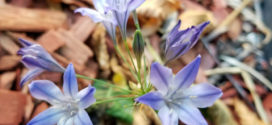
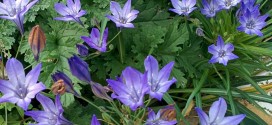
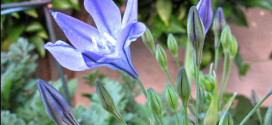
Brodiaea laxa is commonly known as the triplet lily, grassnut lily, or wild hyacinth. This perennial bulb is a native wildflower to California, growing wild in evergreen woodlands. Locally, it is found in places like Edgewood Preserve on the San Mateo County peninsula and Almaden Quicksilver County Park. Grass-like leaves appear first, followed by clusters of light blue blossoms reaching …
Read More »Tag Archives: blue
Phacelia californica
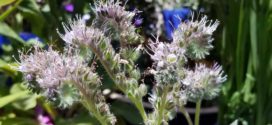
Phacelia californica (California scorpionweed) is a central California native. This herbaceous perennial grows to 1-2 feet tall. Plant in rock gardens or on a slope with good drainage. The common name is because the flowers unfurling from the stalk look like a scorpion’s tail. Less imaginative explanation: it is similar to ferns. The flowers provide an important nectar source for …
Read More »Catmint
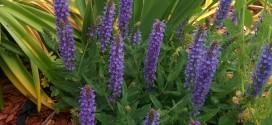
Walker’s Low Flower, aka Catmint. Catmint is one of the toughest perennials you can grow. It’s a proven performer during hot, dry weather, and the silvery foliage and blue flowers look great most of the season. Deadhead or cut back hard after first flush of bloom to encourage more flowers. Average, well-drained soil is usually sufficient. Tall types may need …
Read More »Lithodora
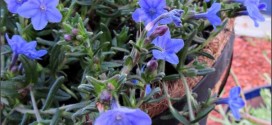
Lithodora is a choice groundcover or rock garden plant. This perennial forms a low, creeping mat of hairy grey-green leaves, studded with royal-blue star flowers from late spring through summer. Plants MUST have a well-drained, acidic soil in order to thrive. Heavy clay soils are sure death. Combines well with Heaths and Heathers, since plants have similar requirements. Evergreen where …
Read More »Brodiaea laxa – Queen Fabiola
“Queen Fabiola” brodiaea (Brodiaea laxa “Queen Fabiola”) is commonly known as the triplet lily or wild hyacinth. It is also known as Ithuriel’s Spear. This perennial bulb is a native wildflower to California, growing wild in evergreen woodlands. It is found in Edgewood Preserve on the San Mateo County peninsula. Grass-like leaves appear first, followed by clusters of light blue …
Read More »Scilla 2015
Siberian squill, grown from a small bulb, is probably the most familiar of the scillas. The plants themselves don’t get much taller than about 6 inches, but they make up for their diminutive size by spreading out and blooming profusely. The tiny bulbs grow and multiple easily and the plants will also self-seed, making scilla a perfect choice for naturalizing.
Read More »