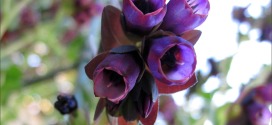
Honeywort, Blue Shrimp Plant, Blue Wax Flower, Cerinthe major ‘Purpurascens’. This plant is attractive to butterflies, birds, and bees. The word “honeywort” means a plant that produces a lot of honey. Average Water Needs; Water regularly; do not overwater Family: Boraginaceae Genus: Cerinthe (ser-IN-thee) (Info) Species: major (MAY-jor) (Info) Cultivar: Purpurascens Additional cultivar information: (aka Purpurescens) Synonym:Cerinthe major …
Read More »Tag Archives: blue
Salvia – Blue Hills
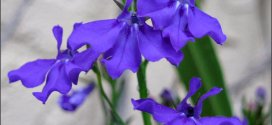
Salvia × sylvestris ‘Blauhügel’ BLUE HILL. This salvia cultivar is a compact plant which typically grows only to 20″ tall. Features densely-flowered, spike-like racemes of pure blue flowers which bloom in June and continue throughout the summer. Flowers are attractive to bees and butterflies. A mint family member which has narrow, dark green, basal leaves (to 5″) and smaller stem …
Read More »Sea Lavender
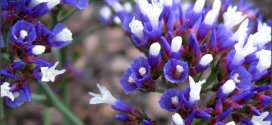
Sea Lavender. Herbaceous Perennial Flower Also known as Statice, Statice Plumbago Limonium latifolium Plumbaginaceae Family Synonym: Statice latifolia Tolerant of droughty soil, this sun-loving perennial delivers dense clouds of blue to pink-purple flowers rising above dark green basal rosettes. Delicate and airy in the garden and as a dried flower. Sunlight: full sun Shade from hot …
Read More »Blue Potato Bush
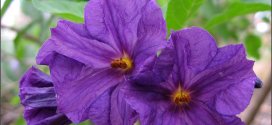
The fragrant flowers of Blue Potato Bush (Lycianthes rantonnetii, also known as Solanum rantonnetii, and Paraguay nightshade), provide a focal point to a tropical or cottage garden. Surrounded by other sun-loving tropical and subtropical perennials, annuals and bulbs, the large shrub blooms year-round in frost-free gardens. Native to Argentina and Paraguay, the blue potato bush is hardy in U.S. Department …
Read More »Pansies
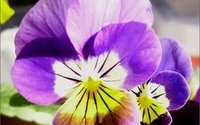
Pansies have colors and bicolors including yellow, gold, orange, purple, violet, red, white, and even near-black (very dark purple). Pansies typically display large showy face markings. Plants grow well in sunny or partially sunny positions in well-draining soils. Pansies are perennial, but normally grown as biennials or annuals because of their leggy growth. The first year plant produces greenery, and …
Read More »Hydrangea
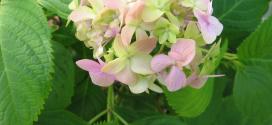
Bigleaf Hydrangea, French Hydrangea. Up until recently, if you wanted a blue Hydrangea, you needed acidic soil; otherwise it was pink. Toxicity: Toxic to Dogs, Toxic to Cats, Toxic to Horses Toxic Principles: Cyanogenic glycoside Clinical Signs: Vomiting, depression, diarrhea. Cyanide intoxication is rare – usually produces more of a gastrointestinal disturbance. Family: Hydrangeaceae (hy-drain-jee-AY-see-ee) (Info) Genus: Hydrangea (hy-DRAIN-juh) (Info) …
Read More »Scilla peruviana
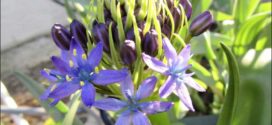
Scilla peruviana is a evergreen perennial makes a spring-time statement with 50 to 100 deep-blue, starry blossoms atop large, cone-shaped flowers. Grow it alongside other spring flowering bulb crops such as daffodils, hyacinths and tulips. These unique flowers have an impressively long bloom time. Short dark green strap-shaped leaves emerge in the fall to form tight rosettes to 18 inches …
Read More »Black and Bloom Salvia
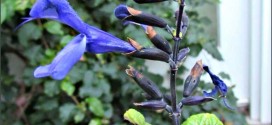
Salvia guaranitica ‘Black and Bloom’ PPAF An improved earlier blooming version of Black and Blue. Another great Salvia option for the mid to back of borders. Deer resistant and heavy blooming until frost. Feature/Bloom: Dark blue flowers mid-spring to mid-fall Evergreen or Deciduous evergreen USDA Zones Hardy to 10°F USDA Zones 8-10 Special Features: Attracts Pollenators, Deer Resistant, Easy Care, …
Read More »Fan Flower
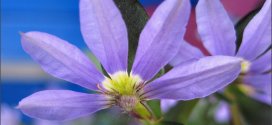
Scaveola, or fairy fan-flower, is a tender perennial from eastern Australia. Although it is a relative newcomer to Sunnyvale gardens, scaveola is rapidly gaining converts as a beautifully flowering cascader for hanging baskets and mixed containers. Description of scaveola: Scaveola has rounded basal leaves and narrower stem leaves on prostrate stems that reach only 6 to 8 inches high but …
Read More »Plumbago
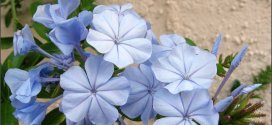
Plumbago can be grown as a bush or a climber-vine. You don’t need much room – I was able to plant it in a 3-inch trench next to a wall. Every winter I cut it back to two feet high. Every year it needs several prunings to keep it from overtopping the 8-foot walls in my Sunnyvale garden. The generic name, …
Read More »