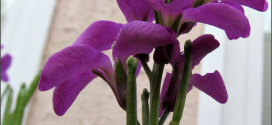
I thought this was a potato vine, but now I am not sure. Potato vines have dark fruit. This vine has white flowers in spring and summer. But the seed pod(s) are about twelve inches long and joined at the bottom. During the summer, I am distracted with other flowers and did not notice the growth pattern of the pods.
Read More »admin
Canna Lily
The canna lily plant is a rhizomatous perennial with tropical-like foliage and large flowers that resemble that of iris. Canna lilies are low maintenance and easy to grow, and both their flowers and foliage offer long-lasting color in the garden. Flower color may be red, orange or yellow. Depending on the variety, foliage color varies from green to maroon, bronze, …
Read More »Herd of Red Zebras
The Red Zebra tomato was the most productive plant in our Sunnyvale garden for 2015. it produced many fruit in the 6 to 8 ounce range. The tomato is meaty with few seeds.
Read More »Brine-curing Your Own Olives
I decided that 2015 was the year to home-cure olives. I visited my parent’s home in Almaden Valley in south Santa Clara County. Their neighbor has a large Mission olive tree that generously drapes over the fence. Olives cannot be consumed without curing. All olives contain oleuropein, a glucoside compound, that tastes very bitter. You have to cure them using …
Read More »Agastache ‘Black Adder’
Okay. I bought this plant because of its name. There were no photos of the flowers; the plant was not yet in bloom. I just loved the 1980s BBC four-year series starring Rowan Atkinson (as Edmund Blackadder) and Tony Robinson (as Baldrick). When the plant finally bloomed last week, I was pleasantly surprised by its purple flower stalk. But, as …
Read More »Fuchsia – Emu Bush
Emu Bush is a great addition to a drought-tolerant garden in Sunnyvale. Emu Bush Fuchsias (genus Eremophila) are Australian shrubby native plants and there are over two hundred varieties known. The name Eremophila means ‘desert lover’ and derives from the Greek eremos (desert) and phileo (to love). The fruits are eaten by emus, which disperse the seeds in their droppings. …
Read More »Asclepias – Silky Mix
One of over two hundred varieties of Asclepias, ‘Silky Mix’ stands out for its beautiful alternating deep red and gold colored blooms. Blooming mid Summer through early Fall, ‘Silky’, like most Asclepias prefers sunny, dry locations and does well in substandard soil. A tender perennial in some zones and annual in others, ‘Silky Mix’ is a beautiful addition to any …
Read More »Tradescantia x andersoniana ‘Sweet Kate’
‘Sweet Kate’ is a compact, clump-forming, hybrid spiderwort that is noted for its unique yellow foliage. It typically grows to 12” tall. Three-petaled, purplish-blue flowers (to 1.5” diameter) accented by contrasting yellow stamens are borne in terminal clusters (umbels) atop stiff stems. Numerous flower buds form in each cluster, but individual flowers open up only a few at a time, …
Read More »Begonia boliviens s. ‘Santa Cruz Sunset’
The Santa Cruz Sunset begonia has dramatic angled petals. These plants fall into the tropical and subtropical category of perennials, growing well in U.S. Department of Agriculture plant hardiness zones 6 through 11. Many varieties with ornamental leaves and blossoms grow well outside in USDA zones 10 and 11, while hardy begonias survive winters in USDA zones 6 through 9 …
Read More »Bellflower
With their nodding heads, Campanula, or bellflower plants, are pretty perennial flowers. Bellflowers will bloom heaviest in June and July but can delight you with flowers all the way into October in some areas. The plant is native to many of the U.S. regions where cool nights and moderate temperatures prevail, creating ideal conditions for growing bellflowers. They require full …
Read More »